
Beyond the Click: How to Measure PPC Metrics That Actually Matter
A PPC dashboard can look healthy while the business behind it bleeds money. You might see thousands of clicks, a strong click-through rate (CTR), and a campaign spending its daily budget on schedule. Then the finance team asks the only question that matters: What revenue did we actually generate?
In modern digital marketing, a click is a vanity diagnostic, not a financial result. What matters is what happens downstream. Does the visitor convert? Does the lead meet your Ideal Customer Profile (ICP)? Does the CRM close the deal – Once you account for operational costs, did the campaign generate profitable growth?

This guide breaks down how to measure campaign success and look beyond superficial PPC metrics to connect them to bottom-line profitability.
A Quick PPC Measurement Audit
Before changing bids, budgets or creative ideas, ask yourself three questions:
- Can you see which campaigns generate sales or genuinely qualified leads, rather than just form fills?
- Can you follow those leads through your CRM to see which ones become customers and revenue?
- Can you explain whether the revenue attributed to PPC was actually incremental or whether some customers would have converted anyway?
If you cannot answer these confidently, the problem may be your measurement setup rather than your media spend.
ROAS vs ROI: The Essential Business Distinction
Many freelancers and business owners treat Return on Ad Spend (ROAS) and Return on Investment (ROI) as the same metric. Doing so is an incredibly expensive mistake that completely distorts your true profitability.
What is Return on Ad Spend (ROAS)?
This compares attributed revenue with advertising spend.
Formula: ROAS = attributed revenue ÷ ad spend
For example, £5,000 in attributed revenue from £1,000 in ad spend gives a 5x ROAS.
That sounds strong, but ROAS doesn’t tell the whole profitability story. It does not automatically account for every cost involved in delivering the product or service.
What is Return on Investment (ROI)?
This takes a broader financial view by comparing the return generated with the relevant investment and costs.
Formula: ROI = (net profit ÷ total investment) × 100
Define the exact costs included consistently for the business. Depending on the situation, that can include product costs, fulfilment, agency fees, software and other relevant expenses.
A campaign can therefore have a 5x ROAS and still produce an unattractive ROI if the underlying margins and costs leave little profit.
How to Measure PPC Campaign Success
The shift in PPC measurement does not mean CTR, CPC, CPA or ROAS have suddenly become useless. Each metric still answers a useful question.
The problem starts when one of them becomes the definition of success.
| Metric Category | Traditional Metric | What It Misses | Modern Measurement Upgrade | What It Answers |
| Traffic & Relevance | CTR & Cost Per Click (CPC) | Measures click volume without verifying if visitor intent matches target products. | Search Terms Insights, Landing Page Relevance & Google Ads Quality Score | Are ads attracting genuine buyer intent, or triggering financial penalties due to poor ad relevance? |
| Conversion Efficiency | Basic Conversions & Cost Per Acquisition (CPA) | Treats low-value form submits identically to high-margin sales. | PPC Conversion Tracking (CRM-Integrated) + Value Rules | Are ad interactions driving qualified pipeline or useless lead volume? |
| Lead Quality | Cost Per Lead (CPL) | Low CPL often hides a high volume of unqualified inquiries that waste sales time. | Cost Per Qualified Lead (CPQL) + Ideal Customer Profile (ICP) Filters | What does it cost to generate a sales-ready prospect? |
| Customer Acquisition | Ad Platform Spend | Focuses solely on media spend while ignoring broader acquisition expenses. | Blended Customer Acquisition Cost (CAC) | What is the total operational cost to acquire a paying account across all channels? |
| Long-Term Value | First-Purchase Value | Evaluates success on the initial transaction without tracking retention or repeat buys. | LTV:CAC Ratio + Payback Period | Does cumulative customer value support initial acquisition spend over time? |
| Commercial Impact | Raw Form Volume | Counts total submissions without tracking pipeline progression. | Pipeline Value Created + Net Realized Revenue | Does PPC generate commercially viable deal flow for sales teams? |
| Causality | Attributed Conversions | Claims platform credit without proving whether advertising caused the conversion. | Incrementality Testing & Conversion Lift Audits | What net-new business occurred solely because of ad display? |
The Real Evolution of PPC Measurement
The PPC landscape has not made CTR, CPC, CPA or ROAS irrelevant.
It has made it harder to justify using any one of them as the whole story.
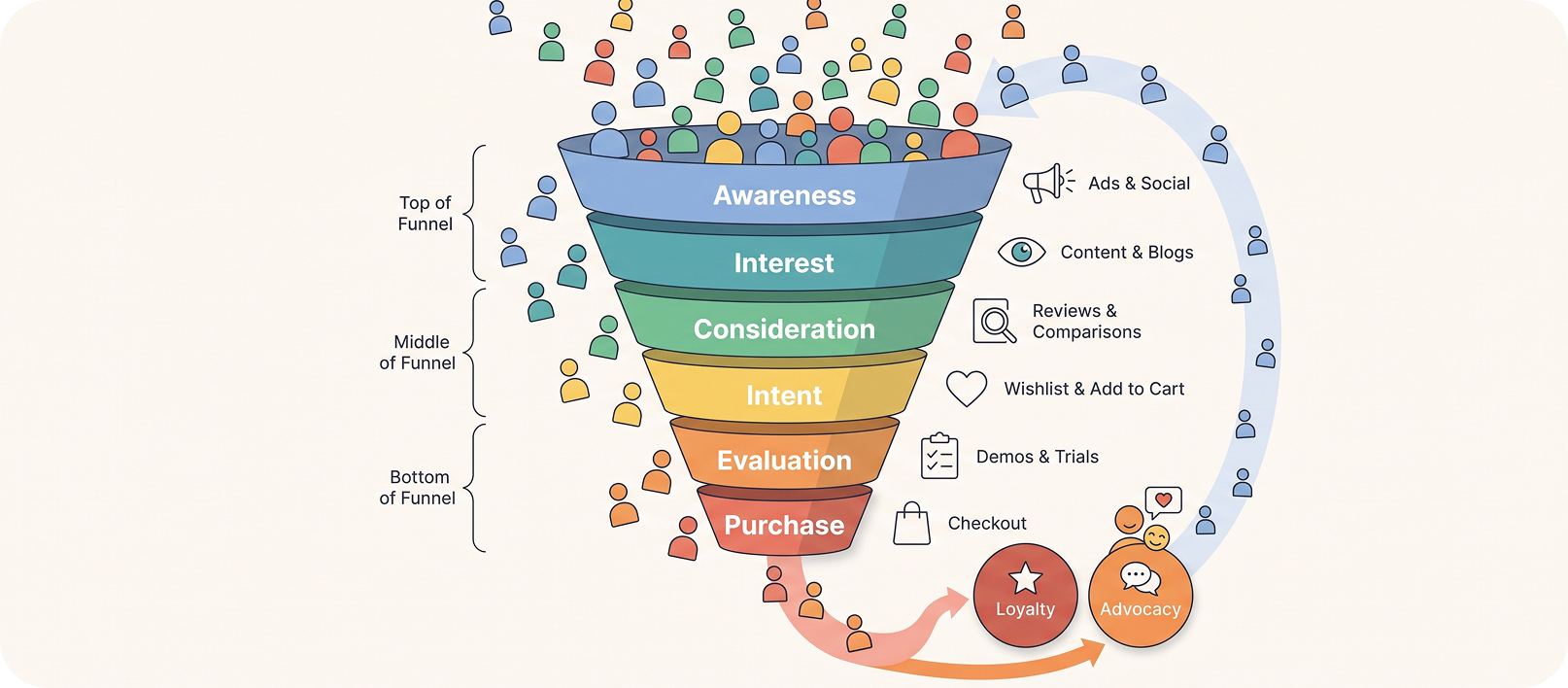
The measurement journey now looks more like this:
Attention → Intent → Conversion → Quality → Revenue → Profitability → Incrementality
The first stages tell you what happened.
The later stages help explain whether it mattered.
That is the difference between reporting on PPC activity and measuring PPC performance.
And as more campaign decisions become automated, the quality of the signals you feed into those systems becomes just as important as the numbers you report afterwards.
Google’s 2026 Search environment makes this particularly relevant. AI Max can expand search-term matching, optimise assets and use Final URL Expansion, meaning advertisers need to understand not just which keywords were clicked, but how search intent, creative, landing pages and conversion signals work together.
Solving the PPC Attribution Puzzle
How does a modern buyer make a purchasing decision? They rarely click a single search link and buy a premium service on the spot.
A typical customer journey spans multiple channels over several weeks:
- Day 1: Sees a mobile social ad during the morning train commute.
- Day 4: Searches your brand name on a laptop via Google Search.
- Day 8: Reads an insightful article on your website to check your credibility.
- Day 14: Visits your site directly to fill out a form and request a consultation.
Attribution is the system used to assign credit across those interactions. Google Ads’ data-driven attribution uses account data to estimate the contribution of different ad interactions along the conversion path, rather than automatically giving all credit to the last interaction.
To run profitable campaigns, you need clean data lines that connect every single touchpoint. Implementing advanced PPC Attribution gives you complete visibility across every touchpoint.
Connecting search channels to your CRM data via server-side tracking helps you invest in the ad creative that drives actual growth.
Attribution vs Incrementality
This distinction is easy to miss and extremely important.
- Attribution asks: which touchpoints should receive credit for the conversion?
- Incrementality asks: what additional outcome happened because of the advertising?
If a customer was already going to buy, an ad may receive conversion credit without creating the underlying demand. Incrementality is harder to measure, but it is the better question when you want to understand whether advertising is genuinely creating additional business.
What Industry-Leading Brands Prove
Leading brands demonstrate that measuring offline conversion events and actual incremental value outperforms chasing raw click volume. When you stop treating ad platforms as isolated revenue engines, your entire financial outlook shifts.
Case Study: Airbnb’s Strategic Marketing Shift
Airbnb’s marketing changes during the pandemic became a useful example of why attributed conversions aren’t the same as incremental demand.
As detailed in Airbnb industry report at adweek, when Airbnb sharply reduced marketing activity, the company reported that traffic recovered to around 95% of 2019 levels without marketing spend. The broader lesson is not that paid advertising is unnecessary. It is that businesses need to understand how much demand their advertising actually creates versus how much existing demand it captures.
As Rand Fishkin, Founder of SparkToro, explicitly warns:
“If you are only optimising for platform-reported conversions, you are essentially training Google’s AI to find people who are easy to convert, not people who are valuable to your business.”
Drive Real Business Value with Tools
As tools get smarter, platforms become more automated, and digital white noise gets louder.
Your next customer is already looking for a solution. They don’t want to dig through bloated code, read robotic copy, or deal with heavy, broken websites. They want an experience that is clear, fast, and impossible to ignore.
To turn paid traffic into real revenue, every link in your marketing chain must fit together perfectly. If you are struggling to fix leaks in your conversion funnel, a skilled PPC management company like Ryetec can help you identify exactly where potential buyers are dropping off.